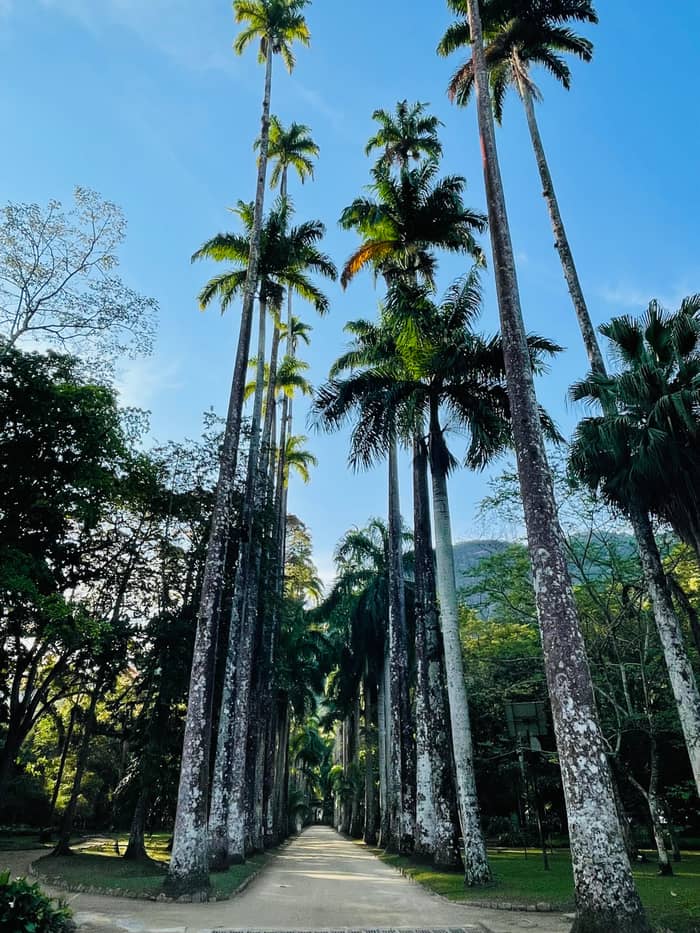
The native monkey
Black capuchin
Native Atlantic Forest monkey
See the toursChecklist you can tick
To-do list · 9 items
Tick items as you finish them. We save your progress on this device.
0 / 9 ready
All ticked. Only the date and your pickup option are left to choose.
Save a placeWhat lives among the palms and lakes of the Jardim Botânico, where and when to look for it, and the rules that keep both visitors and animals safe.
Editorial team, botanicalgardenrio.click · Updated November 12, 2026 · Takes 7 min
Facts at a glance
The short answer to are there monkeys in Rio de Janeiro is yes, and the botanical garden is a reliable place in the city to meet them. The garden's own animal page names the black capuchin, Sapajus nigritus, an Atlantic Forest species that visitors especially like to see.1 It adds that capuchins are the only primates that adapted and survived in the urban environment from the 8 original species of the area.7 That makes every sighting a small piece of local natural history.
The capuchins are doing well in the garden, but the species is not safe in general: despite being well adapted to the garden, they are considered threatened by the IUCN Red List, in the Vulnerable category.8 A good way to treat the animals is as residents of a protected green space, never as props for a photo. They live in the trees, move between the garden and the forest and are used to people walking past, but they remain wild and unpredictable.
Marmosets are the second primate you may meet, and they are a different story. The garden says marmosets, Callithrix jacchus and Callithrix penicillata, come originally from the Northeast and the Centre-East of Brazil, and it counts them as invading species in Rio de Janeiro.2 Since they are not from the region, the garden says they became highly efficient predators and contributed to the decrease in biodiversity and the extinction of native species.9 Enjoy the sight, but do not treat them as the garden's natural wildlife.
Who lives where
| Animal | Where to look | Note |
|---|---|---|
| Black capuchin | Trees of the arboretum | Vulnerable on the IUCN list8 |
| Marmoset | Open trees and paths | Counted as an invasive species2 |
| Channel-billed toucan | Fruiting trees | Reintroduced in the 1960s3 |
| Turtles | Turtle Lake | Exotic, abandoned as pets5 |
| Snake-necked turtle | Frei Leandro Lake | Sometimes on the lilies16 |
| Lizards | Karl Glasl Grotto | Common lizard in the sun17 |
| Bats and frogs | Alleys at night | Seen best on night walks18 |
All animals from the garden's own animal page and its visiting rules; positions on the map above.19
Birds are the other big reason to bring binoculars. Riotur says the garden is a good place for birdwatching,10 and the garden's own page backs that up with a long history of counting. The ornithologist Augusto Ruschi catalogued 138 species in 34 families between 1940 and 1980,4 and a field guide to the garden's birds by Lena Trindade, Henrique Rajão and Plínio Senna is named among the most complete works on the subject.12
The garden gives a direct answer on toucans: the channel-billed toucan and the rusty-margined guan are birds that are always seen and are popular with visitors.13 The toucan had almost disappeared from Rio de Janeiro and was brought back in the 1960s.3 You will usually hear a toucan before you see one, and the most useful trick is to stand still near fruiting trees and look up into the crown.
Among the many species of the arboretum, the garden names rufous-collared sparrows, great kiskadees, blue tanagers, green-headed tanagers, golden-capped parakeets, egrets and hawks.14 Certain hummingbirds, among them the saw-billed hermit and the sapphire-spangled emerald, appear only now and then, either passing through or lying low in winter.15 Rio botanical garden birds therefore change with the season, and a second visit at another time of year can add species that were absent the first time.
The lakes are the best place to start for animals that do not fly. At the Turtle Lake, the most famous turtles are exotic species that were abandoned as pets and now live under the garden's care, and they can be seen in the sun beside the fountain every day.5 They are not native and they were abandoned as pets, which is why the garden's keepers look after them rather than leaving them to spread. The lake is on the map above, at the southern end of the main route.
At Frei Leandro Lake the garden reports a native turtle, the South American snake-necked turtle, which is occasionally spotted on a giant water lily or paddling in the lake.16 The garden's lakes also hold fish: the carp of the Japanese Garden, tambaquis and wolf fish at Frei Leandro Lake, with native angelfish and armored catfish among the local species.21 Stand quietly on a bridge or the bank and the water gives up its residents one by one.
On land, the common lizard Tropidurus torquatus likes to stay in the sun at the Karl Glasl Grotto, while the tegu, Salvator merianae, hides in denser vegetation.17 Anyone asking where to see toucans in the Rio botanical garden can pair the fruiting trees with the lakes, since every sighting loop passes both. The sloth, Bradypus variegatus, can sometimes be seen in the arboretum,22 though sloths are famously hard to spot, so scan the forks of the trees rather than the ground. Use the map pins to link each sighting to its corner of the garden.
Plan your sighting
Pick what matters to you and the garden suggests the time and place.
If I want monkeys
Look at the trees of the arboretum
Capuchins are a visitor favourite and marmosets are common.1,2
If I want toucans
Fruiting trees early in the day
The toucan is always seen and popular.13
If I want something for children
The turtles at the Turtle Lake
They are in the sun beside the fountain every day.5
If I want night animals
The guided night walk
If I want a long forest day
A tour that adds Tijuca
The garden neighbours Tijuca National Park.19
Animals compared
The native monkey
Native Atlantic Forest monkey
See the tours
The newcomer
Small invading monkey
See the tours
The bird
Big-beaked fruit eater
See the toursWildlife follows its own timetable, and the garden says plainly that night is the better time to see mammals, once they leave their hiding places.20 Ingram's squirrels, woolly opossums, big-eared opossums, porcupines and crab-eating raccoons live in the arboretum, and the last three can be seen only at night.40 You cannot wander the grounds in the dark, so the realistic route to these animals is the garden's own guided night walk.
The guided night walk lasts 1h30, takes a minimum of 3 and a maximum of 20 visitors, and its dates are published on the garden's ticket site.41 Frogs and toads are, with the bats, the stars of the night walks led by the Fauna Team.11 The bats that swarm along the tree alleys at night pollinate flowers and disperse seeds, and the garden says they can be seen better on the nightly walks offered once a month.18
By day, aim for the early hours and the late afternoon. Opening times run 8h to 17h from Thursday to Tuesday, and Wednesday begins at 11h,39 so on a Wednesday the morning belongs to the garden staff and the animals until 11h. Exercise, running included, has its own windows, 8h to 9h and again 16h to 18h,42 so expect joggers at those hours and pick your wildlife time around them. Quiet, slow steps will always show you more than a hurried group.
Garden plus forest
Set the party size to price each tour that pairs the garden with the forest.
Side-by-side: 3 options
Set the party size to price each tour that pairs the garden with the forest.
≈
View≈
View≈
ViewAll amounts are from-prices on GetYourGuide, converted at the ECB reference rate. Exact prices are shown at booking.
A day of looking
Opening
Early hours suit birdwatching in the arboretum.10
Mid-morning
Turtles sit in the sun beside the Turtle Lake.5
Midday
Rest in the shade while the grounds are at their hottest.
Late afternoon
Fruiting trees draw capuchins and toucans.3
After dark
Bats and frogs star on the walk.11
The garden's visiting rules are clear about animals. The ban covers feeding animals, bringing them in, taking them out or mistreating them, as well as carving trees or taking any plant away.6 That is the rule the garden asks every visitor to follow, and it applies to the friendliest marmoset and to the smallest lizard alike. Feeding teaches animals to approach people, which is a harm to them and a risk to you.
The garden adds a safety note. Because the animals are wild, not domesticated, they may bite, scratch or sting, and visitors are asked to keep away from them.38 Keep children close and explain this before you go in, because a small hand held out to a friendly face is exactly how a bite happens. Look from a distance, use a zoom lens rather than stepping nearer, and never try to touch a wild animal for a photograph, however calm it looks or however tame its neighbours seem.
A last rule concerns the weather. Strong winds sometimes damage trees, some of them very old, and then the arboretum may have to be evacuated; visitors should leave as fast as possible without running and follow the staff.43 Check the forecast and plan your wildlife time for a calm morning if you can, because a sudden gust is a reason to head for the gate and not a reason to linger under the tallest trees.
Video
ODYSSEY VISUAL MEDIA on YouTube · Until you tap play, no video is loaded.
The mammals are better seen at night, when they leave their hiding places
The garden does not hold all this wildlife by itself. It sits beside Tijuca National Park, where a large area of forest is preserved, and that closeness lets many animal species enter the garden and use it in different ways.19 Some species nest or live inside the arboretum, while others come from the forest to feed. That is why a visit to the garden feels wilder than its manicured lawns suggest.
If you want more forest, Tijuca National Park receives about 2 million visitors a year, according to Riotur.44 A tour that combines the garden and the forest is a practical way to cover both in one morning: the 4 hour site tour combines the garden with a trail through Tijuca National Forest, and the longer 5 hour private tour also stops at Parque Lage. Treat the wildlife as a bonus on any such day.
Parque Lage, next door, has its own rule: it does not allow pets, and it asks visitors not to feed wild animals.45 The same instinct of keeping distance applies there. For the neighbourhood and its other stops, see the page on Parque Lage and the district. Whatever you see, the guideline is simple and the same everywhere in Rio's green spaces: watch, enjoy, photograph from afar and leave nothing behind.
FAQ
The garden says the toucan was reintroduced in the 1960s after almost being extinct.3
Augusto Ruschi catalogued 138 species in 34 families between 1940 and 1980.4
The garden forbids feeding, bringing, removing or mistreating animals.6
The garden says its animals are not domesticated and asks visitors not to approach them.38
Sources
Planning a day among the palms? Ask a real person.